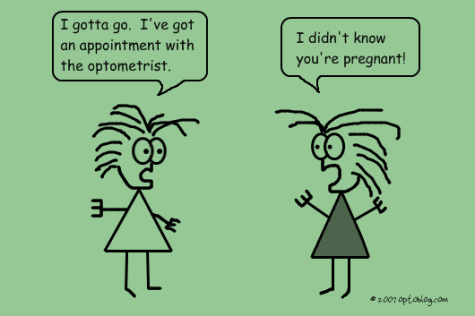
There seems to be a small percentage of ophthalmologists that are vocal against optometry. This is unfortunate because most ophthalmologists work very well with optometrists and enjoy a fruitful relationship with co-management and referral networks.
But I know of a couple ophthalmologists who actively poison their patients against optometrists, especially their Medicare patients. Sure, when they eventually need cataract surgery, they’ll end up in the OMD’s office. If they get diagnosed with certain forms of AMD, then they’ll need a retinal consult. Otherwise, the O.D.s should manage most everything they see.
There are medical models for this. If you get rectal bleeding, do you automatically go to the proctologist? No, you go to your family practice physician. He’ll tell you either: 1) You just ate way too many nuts last night or 2) You’ve got a serious problem that requires more testing and a proctology consult.
So, optometry is the primary eyecare profession, and OMDs would do well to play nice, or we’ll send our referrals to someone who will.
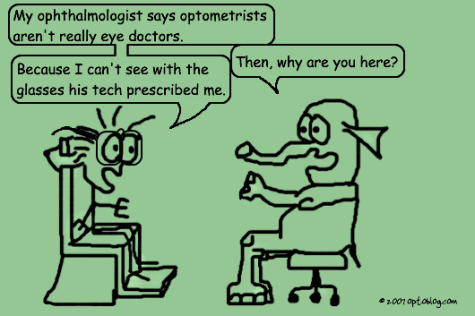
Anyway, the above cartoon is based on a true story. Many OMDs delegate their refractions to their ophthalmic technician. Sure, if you play the averages, then it’s not going to come back to bite you a lot. You’ll recall that in optometry school, we had multiple courses on how to not only do a refraction, but also how to analyze binocular testing data and adjust the Rx accordingly. It’s important to know what symptoms and signs would lead you to do a binocular testing battery, and I don’t think techs are trained for that.
I once observed an ophthalmologist just off his refractive surgery fellowship and starting a new job. He was getting a lesson from his tech about how to use the phoropter. Seriously, can’t ophthalmology residencies spend some course time on this stuff? Would it kill an OMD to at least do a binocular balance instead of just Rx-ing monocular subjective best VA?