web analytics

Archive for the ‘Optoblog’ Category

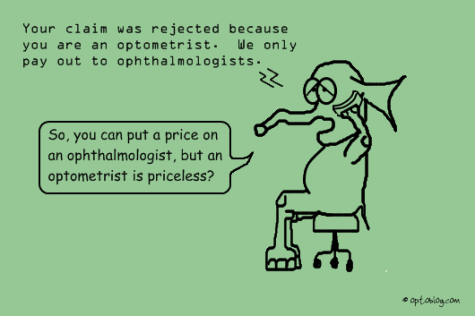
Insurance Discrimination Against Optometrists
David Langford, O.D. on September 10th, 2007 under Comics, Optoblog •  1 Comment

Your claim was rejected because you are an optometrist.  We only pay out to ophthalmologists.  So, you can put a price on an ophthalmologist, but an optometrist is priceless?

In Utah, the major health insurance company is called SelectHeath, a.k.a. IHC, Intermountain Health Care, SelectMed, and SelectCare. What’s funny is that they allow optometrists on their panel in remote areas and even in populated areas like St. George where there are an abundance of OMDs; however, in the most populated “I-15 Corridor” and even in Cache Valley way up north, they only allow our “EyeMD” friends. The notable exception is the Brigham City/Tremonton area.

IHC recently rebranded themselves “SelectHealth, simply there” and claim in their commercials that they are providing quicker access to care, but if they don’t allow optometrists to be paneled then they are actually slowing access to care. Currently in my area, several OMD offices are booked weeks in advance- some doctors have up to a 2 month wait. Word on the street is that the Brigham City area panel was opened for optometry because of all the employees of ATK (rocket engines) in that area. They had to open up the panel for O.D.s so there would be enough eyecare providers for their ATK beneficiaries.I talked to someone in the know. A manufacterer of car air bags had a large number of employees on IHC, yet none of the eye doctors in the area were on the IHC panel, including the OMD. They opted to let an O.D. be panelled (presumably because the OMD was doing surgeries at a non-IHC hospital). Then they later allowed the OMD to be panelled if he agreed to take the IHC surgical patients to the nearest IHC hospital.

But what is the deal with restricting O.D. enrollment? They would pay me the same as an OMD for a routine eye exam, so it doesn’t make fiscal sense…actually, it does when you think that patients get fed up with the long wait to get in with an OMD, so they just pay out of pocket to be seen by an optometrist. IHC doesn’t have to reimburse anything because they went out of network to a non-participating provider. (And the only reason the O.D. isn’t participating is because IHC won’t panel him/her.)

Anyway, I tell patients about the situation all the time, and invariably they say something like, “Oh, it’s all political.” Exactly. They get it. They realize their health plan is flawed. I wish more patients would make a stink to the IHC administrators, but I’ll bet they don’t because they’re used to SelectHealth not being there for them despite what its commercials claim.

If SelectHealth really wanted their beneficiaries to have quicker access to care, they would allow any optometrist to be paneled anywhere.

When will Utah get an Any-Willing-Provider law? This type of discrimination should be illegal.

Corneal Topography for Every Exam?

David Langford, O.D. on September 6th, 2007 under Optoblog •  3 Comments

Until I heard a Nidek podcast, I had never even heard of someone doing a corneal topography on all complete eye exams. Dr. Marc R. Bloomenstein is of the opinion that the information gleaned from a corneal topography is essential in evaluating every patient’s glasses prescription, eye health, contact lens evaluation, and surgery evaluation.

Wow, that thought has never even occurred to me before. EVERY patient? Holy cow, that would take forever with my current corneal topographer, a Keratron Scout. It requires 4 readings per eye, and then it has to download into the computer software. I have to spend a bunch of time to process the data and then finally print out a report for each eye. It does have a CLMI keratoconus screener which I find invaluable, but to do that on every patient would be extremely time consuming.

I actually had the nerve to e-mail Dr. Bloomstein after I listen to the above podcast, and he graciously responded:

So much information is derived from the topography that I feel we can not make informed decisions without this technology. In fact, I was just talking to a group of OD’s in LA last night about the apparent increase in Pellucid diagnosis, when in fact the topographer is just picking it up faster.

I recognize what Dr. Bloomstein is saying because it does give some useful data, but I would like to take a CE class about specifically what I can glean from routine k-topos. I know about the big things like KC, Pellucid, sim-K’s, but I need to know some of the finer details.

Have any of you reading this attempted to perform corneal topo on every patient, or even every contact lens patient? Until now, I have only done it on KC suspects and difficult CL fits and refractive surgery co-management. If any of you have successfully integrated K-topo on every patient, what kind of topographer do you use? Is it fast from reading to report? Did you raise your routine eye exam fees when you implemented K-topo for everyone?

Retasure

David Langford, O.D. on September 4th, 2007 under Optoblog •  5 Comments

Is Retasure a good thing? Systems like this have been in place with the Indian Health Service in certain areas of the Southwest, but more on that later.

The Utah Optometric Association took exception to Retasure only saying the word “Ophthalmologist” and never even allowing for optometry to enter the picture. I take exception too, but if they have significant problems, they would go straight to the retina OMD guy/gal anyway; however, what are their referral criteria?

With any result other than no pathology, the American Academy of Ophthalmology and the American Diabetes Association recommend an immediate referral to Ophthalmology.

If there is any amount of retinopathy, they still refer to ophthalmology. Note, it doesn’t even have to be a retina specialist. General ophthalmologists are getting referrals that I, an optometrist, can manage. I can discern whether DR requires a procedure vs monitoring at specified intervals. Even after a procedure, I still monitor them and call or send a memo to the retina guy/gal about their progress. This exclusive “ophthalmology” wording is sick and wrong.

And I’m sure the system could be a potential cash cow for the PCP, but only if he has everyone do it- even if they would normally go see an eye doctor yearly anyway. I can foresee lots of patients getting upset if they find out their annual eye doctor visit isn’t covered because they already took a Retasure picture in the PCP’s office, so now they have to pay out of pocket for an eye exam to check their glasses. And us eye doctors are also going to want to check their eye health, and even if they could produce a Retasure photo, what about the anterior segment, vitreous, and peripheral retina health?

So, Retasure, did you really forget about optometrists or are you trying to make a political statement? Are you prejudiced against us? Do you suppose us not worthy to refer to? If so, check our training. We can handle diabetic eyecare. We also send notes to PCPs regarding the results.

But what about you? Do you really think this is a good system? Does it best serve diabetic people to be screened with this verses getting comprehensive eyecare annually? Eyecare which they probably want anyway so they can update their glasses and such? Also, in the Indian Health Service, they use this type of remote viewing system only in rural locations where there aren’t any eye doctors. Why do we need Retsure unless the PCP office is a significant drive from the nearest ophthalmologist OR optometrist office? And how many PCP offices fit that description? I’m sure not enough to make a profit for you.

All This New Technology

David Langford, O.D. on September 2nd, 2007 under Optoblog •  Comments Off on All This New Technology

Have you all seen the future of visual field testers?
picture of the TFA
It’s made in Australia. I heard about it from medGadget, and you can read all their ophthalmology entries if your interested.

Sicne patients don’t have to press a button and it’s a short test, I’m hoping this would be a great test for geriatric patients.

It appears to me that we’re always going to have to update our equipment every couple years. What kind of practice setting allows us to do that? I bought an HRT2 last year, and now the latest edition of Review of Optometry equipment guide doesn’t even mention it! Should I always expect my income to be subtracted by thousands of dollars so I can always buy the latest and greatest tech?

Advertising Optometry Stuff

David Langford, O.D. on August 31st, 2007 under Optoblog •  Comments Off on Advertising Optometry Stuff

Ha-ha. You all are going to have a big laugh about this. An internet contact lenses price comparison website contacted me about possibly advertising on my blog. I think that’s pretty funny since you and I sell contact lenses in our respective practices, so why would we want to advertise to buy them online?

Anyway, I was thinking about more appropriate advertising, like products from ophthalmic distributors. But being a blogger, I’m not sure I want to accept advertising money because I want to avoid bias. What I would rather do is have vendors contact me about simply test driving their products, and then I can write a review about them.

If vendors think they have a cool product ready for prime time, then they shouldn’t be afraid of anything that a regular optometrist in the trenches has to say about it. Any publicity is good publicity, right?

Vendors, e-mail me at: david at optoblog dot com if you want me to test drive and give an honest opinion of your product.

Indian Health Service in the News Again

David Langford, O.D. on August 28th, 2007 under Optoblog •  Comments Off on Indian Health Service in the News Again

An interesting article about the Indian Health Service. Hat tip to Kevin, M.D.

I used to work for the Indian Health Service. By the way, I loved it. The work was great. The pay was acceptable*. The people were great. But we all know the system has problems, but an IHS optometrist is insulated from most of those problems…until you try to get a cataract surgery for one of your patients. We had to wait until the vision was 20/70 or worse before Contract Care would consider paying for a referral.

The reason? There’s no money!

*I didn’t leave because I was unhappy with pay. My wife’s and mine extended family is based in Idaho and Utah, so we left the service and moved back to Utah to be closer to the fam. That’s important to people like us. I would have transferred to Fort Hall, ID or Fort Duchesne, UT but these locations had just been filled by optometrists who look like they are going to be there for the long haul, so I saw no chance of being any closer than 8-9 hours away from extended family unless I went into the private sector.

Cool Tech in Glaucoma Management

David Langford, O.D. on August 16th, 2007 under Optoblog •  Comments Off on Cool Tech in Glaucoma Management

I saw at medGadget a commentary about MIT’s Technology Review coverage of a computer chip surgically implanted in the eye which continuously measures IOP.

MedGadget says:

a pressure sensor to measure glaucoma continuously, instead of once every 6 months in the ophthalmologist’s office.

I would just change that to read, “instead of once every 3-6 months at the optometrist or ophthalmologist’s office.” 😉

But I was wondering at what point we implant these devices? Is the risk of the implant operation justified for a glaucoma suspect? If we already know the patient has glaucoma and we are managing with maximum therapy, do we need the implant? Can we even get insurance companies to come on board to pay for the chip and implant operation?

Optoblog Interviewed for Australian Optometry Newspaper

David Langford, O.D. on August 9th, 2007 under Optoblog •  Comments Off on Optoblog Interviewed for Australian Optometry Newspaper

Emily Webb wrote an article about optometrists and blogging for the newspaper of the Optometrists Association Australia. I’ll link to her article if they make it available on their website. She sent me a copy of the original print version and it’s found in Volume 28 Number 8 August 2007. Another optometrist interviewed is Dr. Stuart Macfarlane. For now I’ll just post the original transcript of my e-mail interview.

Emily Webb wrote:
> Hi David,
>
> It will just be a few questions:
>
> 1. Why did you start blogging?
>
I was introduced to blogging by Intel blogger and friend, Josh Bancroft, of tinyscreenfuls.com. It was when I went back to visit Portland during the October 2004 GWCO conference. He introduced me to the wonderful concept of web site syndication and the blogs that were using it. He also introduced me to the Clue Train Manifesto (cluetrain.com) which my take home message was that people want to give feedback to companies, and the companies should listen and change for the better in response to the open conversations they have with customers.

With optoblog.com I started out wanting to share optometry news and write reviews for ophthalmic equipment- like engadget.com and arstechnica do with computers and electronics. But I found out that just repeating the news I read from sources like AOAnews.com and revoptom.com is redundant. I don’t have to be a news machine if these source authorities would simply publish an RSS feed for their updated content. Instead, I try to focus on how I can be “part of a conversation” and what significance the industry news has for me. I would like to write more reviews, but they are more time consuming compared to jotting down a few rants about the state of the profession and ophthalmic industry. I wish more optometrists would give feedback to the ophthalmic vendors because improvements need to be made in the usability of products like PM/EHR software and digital exam equipment.

I’ve recently added a new feature: cartoons. My inspiration derived from savagechickens.com who draws hilarious cartoons on a yellow sticky note. Mine are on a sea-foam green back ground (like optometry thesis project report covers), and they’re kind of like political cartoons except they are just about our profession. Sure, the art is bad, but they could bring a smirk to your face.
> 2. What positives/benefits have come from the blog?
>
This request for an e-mail interview from an Australian writer is a highlight. I think the industry vendors have finally caught on to seeking feedback. Just this week I saw in my website logs that someone with an IP address from Johnson & Johnson (Vistakon-Acuvue) browsed around my blog and then searched my site for the word “Ciba.”
> 3. What do you like about blogging?
>
I can express my opinion, and maybe someone will validate it for me. I don’t get the opportunity very much to speak with my optometric peers about the state of our profession, and it’s my hope that blogging will start conversations with other optometric physicians. I could be way out there on a particular issue, so it allows me to go on the record, get the opinions of others, and then re-evaluate my stance. I hate the current state of web boards because they usually are exclusive and talk in secret behind closed doors. The ClueTrain Manifesto is all about open conversations, and I subscribe to that philosophy.
> 4. Your advice to novice/would-be bloggers?
>
I got into the geeky world of getting a web host and using WordPress.org for the back-end of my blog. It requires a lot of maintenance. I would just open an account at blogger.com or wordpress.com and let them take care of your back end- er…the technical side that requires almost constant tweaking and security updates. Ready-made solutions would allow you to focus on your content, ideas, and conversations.

Also, don’t dwell so much on the negative and writing rants exclusively (do as I say, not as I do).
> Also, do you have a photo you could email? It needs to be high res
> (300dpi) and preferably a portrait.
>
The best photo that I’ve got for now is attached. It’s taken with my digital camera at 72 dpi but the pixel size is 1280 x 960. When does this publish? If you gave me a few more days I might come up with something better.

Thanks for the interview!
-DJL
optoblog.com

David Langford, O.D.

> Cheers,
>
> Emily
>
>
>
> —–Original Message—–
> From: David (optoblog) [mailto:david@optoblog.com] Sent: Friday, 30 March 2007 3:43 PM
> To: Emily Webb
> Subject: optoblog interview
>
> Sure thing. I can do an e-mail interview. I’m just some cheeky
> American who has only been in practice for 4 years, but fire away.
> For your background information I have attached my C.V.
> -David Langford, OD
>
> Emily Webb wrote:
>
>> Emily Webb wrote:
>> Hi David,
>>
>> I am a journalist with Australian Optometry newspaper, the member publication of Optometrists Association Australia. I am writing a feature on blogging and I’d love to interview you with a few questions via email. My email is [******]
>>
>> Cheers,
>>
>> Emily Webb

Cool Optical Lab Site

David Langford, O.D. on August 7th, 2007 under Optoblog •  4 Comments

I needed to know what brand/style of PAL a patient was wearing, but I’ve always been too cheap to pay $36 for the Progressive Lens Identifier book from the OLA, so I searched to find an online version. An optiboard thread linked to Laramy-K Optical’s website. They have their own progressive lens chart, complete with laser markings.

And they even have a blog (although no RSS feed for posts, but curiously they have one for comments). They had even talked about me! That reminds me, I need to find some time to draw more cartoons. Ever since I stopped working at Lenscrafters, I haven’t had time to draw.

Anyway, Laramy-K gets my vote for one of the coolest optical lab websites.

Patients Say the Funniest Things

David Langford, O.D. on July 30th, 2007 under Optoblog •  15 Comments

I was in the contact lens room watching a patient put in the contacts that I wanted to give him. I mentioned how the prescription would be good for 2 years per Utah law.

“Wow, is that new?” he asked.
“Umm, it’s pretty new. The state lawmakers got together and decided that’s how it should be,” I answered.
Then he said, rather sardonically, “Why, because they’re all doctors?”

I laughed out loud. It’s so true. When lawmakers decide to micromanage an entire healthcare profession by telling us how long we have to make a prescription good for, then I think they better have some proof that this new policy won’t cause more problems than it helps. Where is their research that supports such a sweeping change? And the research can’t come from 1-800 or Canada because we know they have a biases.

Now, the Utah law does say that I can make it for less than 2 years as long as I document some medical reason why it should be less. So…since nearly every contact lens patient I see was brought up on AV2 contacts (or some other low oxygen lens that is cheap), I think I could probably make a one year expiration on most everyone since most everyone in that category has mild corneal neovascularization.

So do I? No, because I switch almost everyone into a high oxygen lens, my preferred method for treating K-neo, so if they’re wearing an AV Oasys or Ciba Night and Day, what more can I do to help them?

But if they refuse to switch to a more costly (yet healthier) contact lens, then I explain how we should decrease their wearing time, maintain an approved replacement schedule, and monitor it next year.

One question for you all. Why do you insist on telling your patients that it’s okay to throw away their Acuvue2 lens once a month?!??!! IT’S A TWO WEEK LENS!! You are the reason I see so much K-neo. I hope you’re proud of yourself.